
Truer than True
Making the Common Good Sticky

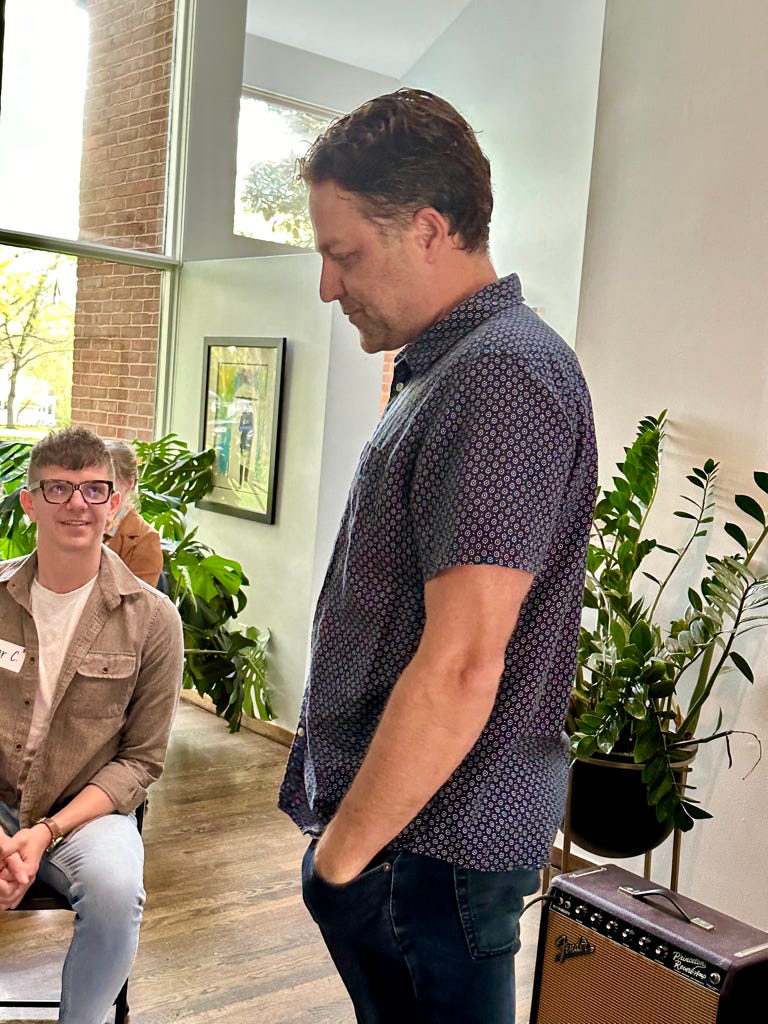
For the concluding night of the Common Good Book Club, Brad provided the connective tissue through his facilitation. Check out the video and transcript below. The transcript is full of links to take you to particular movements and moments from the night.
Brad: Welcome everyone. If we haven't met yet, I feel like I talked to everybody, but if I haven't, I'm Brad. I live here. And thanks for coming. This is so great to see a bunch of old faces and new faces. You're probably wondering what's gonna happen tonight. And so am I. I don't really know. This will be the third night of not really knowing what the heck is gonna happen. But here is generally what we're doing… We're exploring this myth of the Exodus story and not in any sort of religious sense. There's a wide variety of folks here, but we were talking with a guy named Walter Brueggemann when we were trying to figure out…Joey and I and some of you in this room have been interested in this idea of the Common Good for years now. Whenever we hear some of our mentors like Peter Block or Walter Brueggemann talk about it, when we're in their presence, it sounds magical. And we're just like, yes, we're all in on this idea of the Common Good. And then when we're away from them, we're just like, ‘Now what were they talking about’ There's something about it that doesn't stick. So, COVID hit, all this stuff happened, and Joey and I were trying to figure out, how do we make this a little more sticky? Because we feel like there's something there… that we are supposed to take care of each other. That we are supposed to explore this idea of becoming more of ourself in some sort of Common Good community thing. But why does it not work? Like, why does the mythos of America of pull yourself up by your bootstraps and this sort of individualism thing, why is that so captivating to us but this idea of the Common Good not? And what we came to realize through the help of some mentors is that it's because there's not a strong myth connected to it. We have one of the cowboys going west and all of that for America… it's really easy to wrap our ideas around it. But when it comes to the Common Good, there isn't one.
The folks that we've studied under, they pointed us in the direction of the Exodus story because they've said it's not necessarily literally true, could be, but that doesn't really matter. It's truer than true. It's a story that anytime a group of people walk out into some sort of metaphorical wilderness to go try to find freedom together…it keeps happening over and over and over again. So this story of Moses and the Israelites, it's a story that happens any time that people come together to go find this sense of freedom.
And so this is now the third night that we've, and the first night we've covered a few weeks of the story, then the next one was maybe like a couple months. And this one is like 40 years worth of story that we're going to have five different people do their interpretations of tonight. So we're going to skip a lot of stuff. So if you're someone who's really into this story, it may drive you crazy all of the things that we're skipping past, but try not to worry about that. But I'm going to ask our friend Miriam to catch us up story wise, for those of you who are just joining us tonight where we've been and then where we're going tonight, in general, just so we have some things that we can hold on to.
Miriam: Hi, I'm Miriam. And I'm going to speak just from my own context on the story itself so if one of the words that I said doesn't work for you, you can just supplement it with one that does, knowing I'm trying to highlight the metaphor of the story.
So, the Jewish people observe this story as a holiday called Passover and the commandment to do that comes from the Mishnah, which is a 3rd century text, that says in every generation, you have to imagine yourself as though you were redeemed from Egypt. Egypt is referred to as Mitzrayim, which is actually The Narrow Place.
So, we're always supposed to tell the story in very specific ways so that we can then embody the story. And of course, because we're humans, we forget about it 40 days later and have to do it in another kind of holiday, and then another kind of holiday, and another one, until we get back here and we realize we're doing the same thing but maybe a different angle of that same story.
The way that we handle telling this story in a ritualized way is through the asking of questions. Again, in that same text of the Mishnah, it says that we are supposed to engage with the story through questions. And if you have children who aren't able to ask questions, you can provide some. And so one of the ways that we think about this whole thing we're doing is through the lens of questions, engaging with it deeply so that we can then embody that story and make it our own.
I think something that's interesting about the context of the writing of this particular story is that this can't be about Egyptians, there are no Israelites in Egypt. There's no proof that any of that was built by that particular people… there's no science for that. But what's probably more likely is that this text was written in exile and the big bad wolf of that time for the Israelites were the Babylonians. So the Babylonians are actually the bad guys, but you can't be living in the bad guy’s house and saying bad things about the bad guy. So you say it about these other people and we do it in words of metaphor by saying, ‘these other people,’ though it's a real word of Egypt, it's also Mitzrayim, this narrow place. And so once it becomes a metaphor and it's not so rooted in this actually happening this way, the questions open us up differently.
And so the part we're at now, which is we were just redeemed from a narrow place, from Mitzrayim. There were a lot of plagues and hardships that happened to us and then we got to the sea and there wasn't another miracle waiting for us. Our oppressors were chasing us. And when we get there, the first one walks into the sea, and then the next one, and then the next one. And once all the water's up to our noses, we can barely breathe. And God looks down, or the ‘is-ness’ of the world, or what makes us all powerful, whatever the word is, looks down and says, ‘I believe in you,’ and they believe in themselves and they walk to the other side. And so that's where this part of the story will start today, taking us through the journey and trying to manifest that in every generation item, that Kol d’or v’dor for this moment, to embody and to ask sacred questions.
Brad: So, what's going to happen is there's going to be five different stories told by five different pairs and these five pairs were given the text and they had a chat with Joey and Miriam. Then they interpreted how they're going to tell the story. Very exciting. My favorite thing in the world is watching people make stuff, so this is such a treat tonight. The first night we used this old school projector, and that was cool. And then the second one we did toasts and that was cool, and tonight we're doing letters. So the context of everything is going to be letter writing. We thought that was clever and Joey was talking to Yalie, and she's like, ‘Oh, you're doing epistolary…’ like, there's like an actual word for it, right? And we're like, ‘Oh, we're not clever at all.’ So yeah, letter writing. Five people. We're going to, every now and again, take a little break and you'll talk amongst yourselves. I’m trying to give you context for what's going to happen so the unknown doesn't freak anybody out. We good? So our first story, Jack and Rachel, you ready? Come on up.
Brad: That part of the myth was that when you're doing something hard, it's always harder than people think and they complain about it. That feels truer than true if you've ever tried to get people to go do something. The next part of the story you're probably familiar with, even if this isn't a story that dived into as a religious person…it's when Moses goes up to the mountaintop to get the Ten Commandments. Let's give it up for Devin and Yalie.
Brad: Let's take a little breather today, yeah? Maybe just close your eyes and take like a slow deep breath in and out. Do that again, just a slow deep breath in and out. I need one more. Slow deep breath in. Out. Okay. We're gonna take a little break with each other. You're gonna talk amongst yourselves about what's struck you so far. Could be a word, could be a moment, could be a thought, could be a feeling, could be anything. But share that around your table. And then there's postcards at your table. You're gonna grab one that calls your name and it says, ‘I'm your postcard.’ And you'll pick it and you can put your name and address on it. And it'll be yours and we'll do something with it later. Good? Pretty good so far, huh?
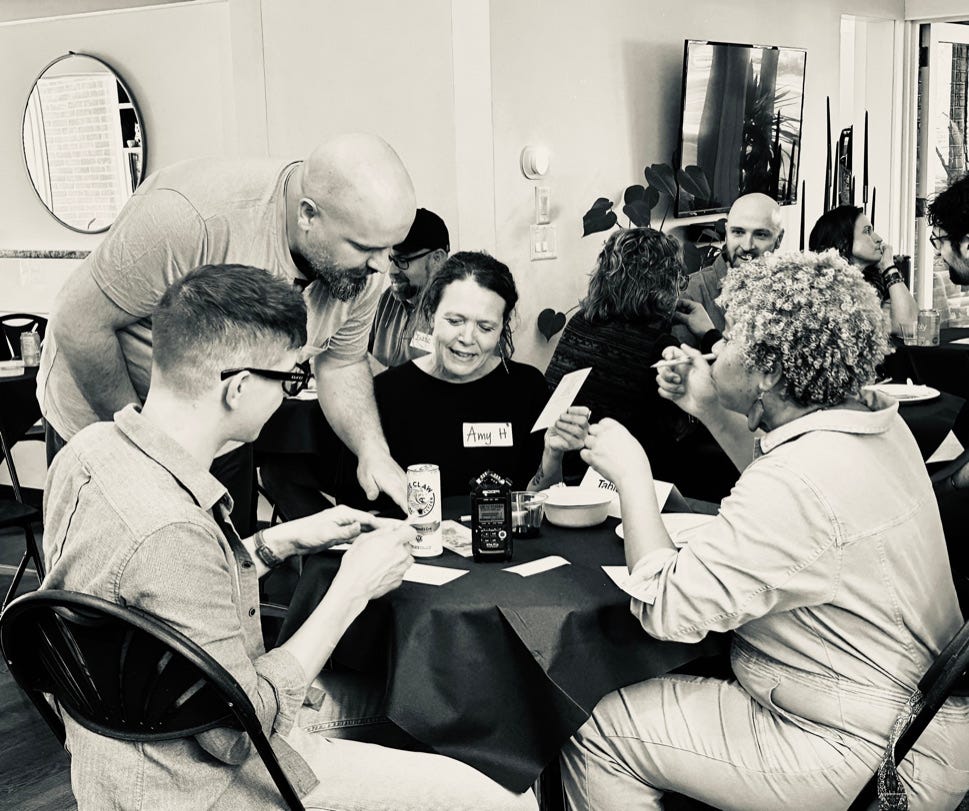
Brad: Okay! We're going to keep rolling. I would love to hear from the groups if there was any sort of ah ha moments or things that you want to share with the large group. We'll do a quick popcorn sharing of what's popping for everybody. And then we'll go into our next part. So who wants to share? Not everybody all at once though, that's always awkward. Bill!
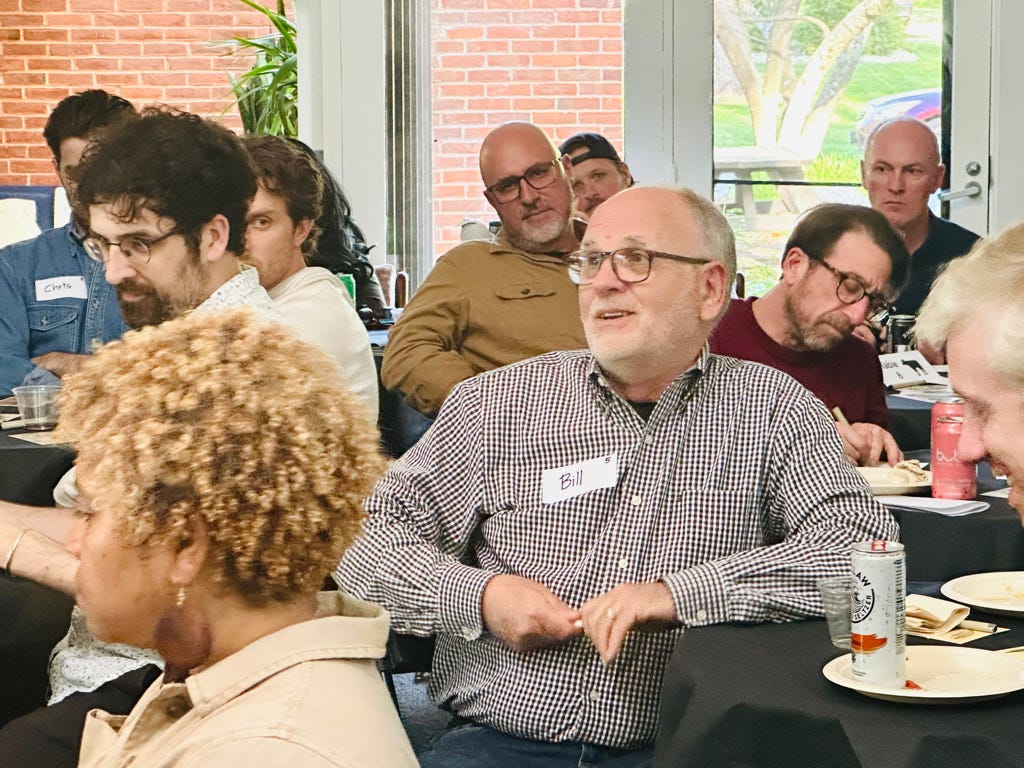
Bill: I'll be brave. So on the way here I was listening to a program where a woman had rewritten the story of Genesis as a graphic novel and recast God as a woman, who instead of having this confidence and ‘look at what God created, it's all perfect;’ instead she had doubts. And so thinking about the suggestion box, it was like thinking about all the doubts we have and thinking about all the doubts that existed in whatever that historical context was and realizing it's all the same. And we can write the story however we want to. Our own graphic novel.
Brad: Yeah, that's good. Doubts. Who else?
Brooklin: I'd like to say thank you to Devin. The honesty that you brought to this space in that song… I was like gonna listen to it beforehand because I have an inside scoop but I wanted to be surprised and I'm so glad that I was. You captivated me inside of that story in a way I've never experienced before.
Devin: Sweet. Thank you.
Brad: Yeah, it was beautiful. Can I put you on the spot and ask you a question in front everybody? Is it okay?
Tyler C: Oh my gosh, yeah.
Brad: I noticed some emotion after Yalie’s poem.
Tyler C: Who, me? Yeah!
Brad: Can you share what that was about?
Tyler C: This is some of what I shared with our table… if you haven't met me, I am a strategist. I am driven. There's steps. I research and there’s always a plan. And a dear, dear friend of mine, who I love working with, we create spaces together… she is… it's intuitive, it’s gut feelings, it's all that. And I love the beauty of that relationship. But there's a lot tied up in this tension between, ‘Girl, if we do X, Y, Z, and I call these people and we do this thing, it'll work.’ And then like, ‘But no, that's not it.’ And the word that Amy reflected back to me as I was processing here is to respect intuitive ways of knowing both in others and then also my own intuition, which I think is usually shoved aside for the strategy. It was just like, my goodness, I don't always don't do that. So there were real stories coming up and then of course, who doesn't love a beautiful poem? But it all of that together was like, oh my gosh, that is not a way of knowing I lean into and I've seen both real costs from that and then I was also like, oh, there’s some real potential in trusting that more.’
Brad: Cool. Thanks for sharing. Anybody else? Okay, so our next story Moses is up on the mountaintop. That's where we're at, right? He's experiencing some doubts and then all of the people are left elsewhere. And some wild things maybe start to happen. And y'all are gonna do something cool. So give it up for Brooklin and Ryan.
Brad: I love it. So, the idea of that story was that when we're left alone and we're on a journey, we can feel pretty lonely. We make stuff together, right? We get creative and then we feel less lonely… when we journey to make things together. And that bird was amazing. Our next, next story is from Shanda. Want to come on up? And David. Give it up for Shanda & David.
Brad: Alright, we're going to do a quick reflection. And then we're going to talk amongst ourselves again. So, if you can get both feet on the ground. And maybe close your eyes. Take a nice, slow, deep breath in. And out. Do that again, slow, deep breath in. And out. Maybe wiggle your toes a bit. Pay attention to how your seat feels on your seat. Just try to center yourself a little bit so that we can explore some things. And just keep paying attention to your breath.
So we've been looking at this story and this idea of when we're en route to Promised Land… When we're on our way to go to some place that we've been dreaming about, some place that's been promised… doubt creeps in. Fear comes shortly after. And we start to tell ourselves stories and we start to listen to stories. And so I'm just wondering, as you think about that for yourself right now, is there some sense of Promised Land that you feel like you are walking toward? That you're journeying with a group of people? And does it ever feel like you start to get close? And then immediately far? What kind of stories do you tell yourself or are telling yourself right now? Are they hopeful? Are they fearful? Are they childlike? [As Rainey coos in the background] Is there a sense of innocence and wonder to those stories, or is there a sense of adultness that just lists everything wrong with them? And when you're on that kind of journey, who do you reach out to? Do you have a person that feels like a pen pal? A person that you can engage with to hear their story? And what do they say?
So, you can take a big, deep breath in. And out. Maybe something came to mind… maybe another person at your table had something came to mind and then they'll spark something else for you to think of. We're just gonna have a small conversation around our table of what's coming up so far, and maybe on that postcard that you put your name on, write the one word that you don't want to forget or the one word that's coming up. Something that kind of encapsulates where we are so far in the night.
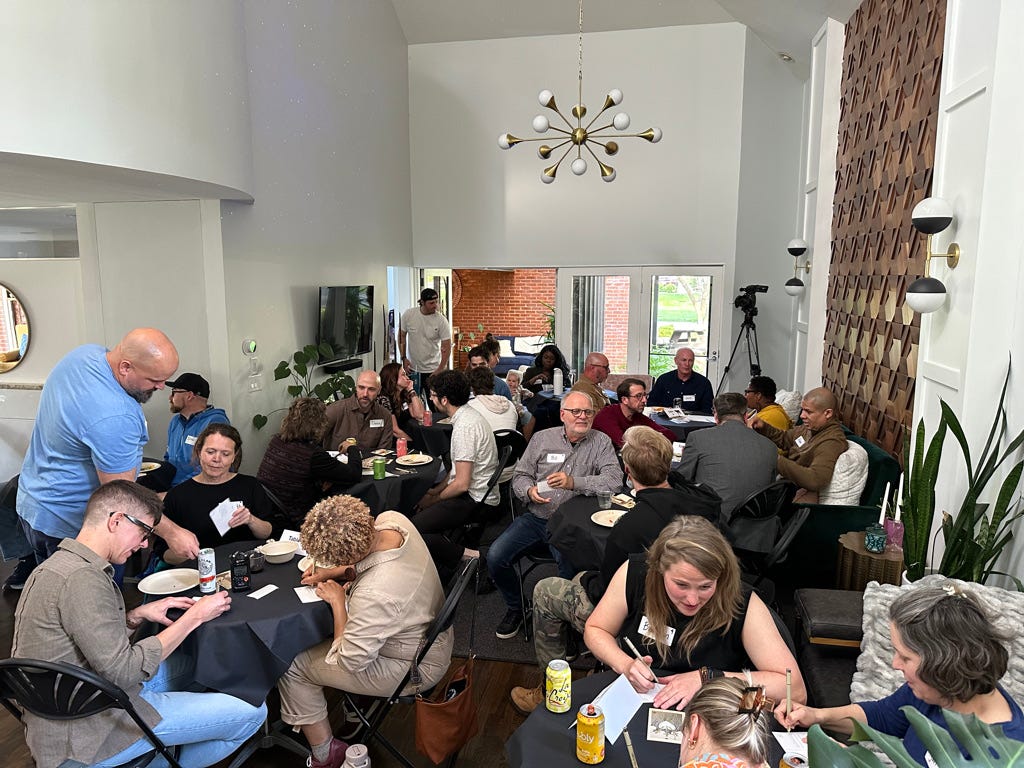
Brad: I want to hear from some of you. What were some of your words? What stood out? Was there any threads amongst the table that you were connecting? Fire them at me. What's popping?
Jack: So we had a theme of perspective but it showed up in different ways. So one of the ways that it showed up in the group was the idea of childlikeness. So, to remember what it means to not have the crap of being an adult and to make a decision without that weight or worry that we carry as adults. And then, the other words were sort of like, reality within that same theme of… what is our reality? So, all the complaints in the comment box came from the idea of going to Moses, like, ‘This is our complaint,’ but then Moses going to God and saying, ‘These are my complaints about all these complaining people.’ And so, you have to then think about perspective of leadership… is there a message that I should be getting from the people that I need to think about? And then as a leader, should I also have the perspective of those people? And also, they're being kind of whiny and we gotta move forward.
Brad: Yeah, that's good. Thanks, Jack. Anybody else?
Amy: Yeah, one thing that came up here was just the power of how do we open up to what's possible? Holding both the fear, the mind, some of the adult stuff that was important. They had real fears, but what came up for in our in our group was the statement, Miriam, you said it… the others are scary because they want to eat. That went straight to my heart. How sad. What a sad statement, that the adults thought they were scary because they just wanted to eat. And this is real. It's happening in our world all the time. And the children could see something more. They could see like, ‘Of course we want them to eat because they're my friends.’ So, how do we move from our heart, open our hearts and move from there. I could go on and on, but let me just shut up there. It's important. It's like the time we're living in, it's calling us to do that. I think it's very much connected to the reason why we're here, which is to explore the Common Good. How do we actually tap into that and come to know that and work for that and create that?
Brad: Yeah. There was a line from Devin's song where it was like, ‘Did you call us out here just to be alone?’ Did I get that exactly right. That was the heart of one of the lines that really struck me. When you start something…
Devin: Did you set us apart to be alone?
Brad: That's a good line. Lots of good lines in that song. Alright, we're going to enter into our final story! This is the part of the story where Moses goes up to the mountain, a different mountain than what he's been on, and realizes that the old boy's not going to make it to the Promised Land. He did all this work, lots of things. He was a part of a whole water being parted and tons of things, but he's not going to make it to where he thought he was going to make it to. And this is that story from John and Joey, so give it up.
Brad: Wow! I got chills. That was amazing. You were incredible, John. Joey, thank you. I can't wait to get the lyrics from Devin's song and Yalie's poem and what you just wrote in your poem and everything everybody made tonight, it was unbelievable. We're going to close by writing on one postcard. Y'all are going to write a letter to this present moment of what the point is. What you're grateful for. Whatever it is that your table feels like you want to log down as memory of what this present moment means to you as a table, to us as a group. Write that down so that we have a record of it and do it together because that's the point. We'll do that and then we'll almost be done. I'll be back up in a few minutes.
Brad: Here's what we're going to do. We're almost done. What we're going to do is… I'm hopeful that each table will be willing to share the letter you wrote to the present moment. I didn't tell you that beforehand, so if yours is only for you and you don't feel comfortable doing that I'll give you a pass because I blew it. But if everybody can pop up and do that, that would be amazing. So who wants to stand up and go first?
Brad: Here's how we're going to end… In your tables, you're just gonna share the gifts that you received from each other tonight. Go one by one, if you've never done it before, and you're just saying, ‘Amy, the gift that I got from you tonight was your openness in the way that you listen to me, thanks.’ And you share a gift around your table. So, share gifts and then you can go.
Miriam: Thank you Brad and Leah for your house.
Brad: You don't have to leave immediately. I mean, you can leave immediately but you don't have to.
Joey: There might be a fire if you want to stick around. 🔥